
What Is Seedance 2.5? ByteDance's 30-Second Video Model, Explained
Seedance 2.5 is ByteDance's 30-second, 50-reference video model with native audio. What it does, what drives its cost, where it still falls short, and how to run it in your browser.
 The Seadanse Team16 min read
The team behind Seadanse. We run the models we write about, and we publish the specs, prices and limits the marketing leaves out.

TL;DR — Seedance 2.5 is a next-generation AI video generation model by ByteDance. Released on July 31, 2026, it renders continuous takes up to 30 seconds. It makes synchronized audio in one pass, accepts up to 50 reference files, and lets creators edit existing footage by timestamp. The model runs in ByteDance tools like Jimeng and Doubao Pro. It is on Volcano Engine Ark and BytePlus ModelArk APIs since August 7. You can also run it on the Seedance 2.5 AI Video Generator. The biggest jump is length and reference control, not resolution. Budget carefully for 30-second takes. Expect physics to wobble in busy action scenes.
Most AI video tools generate clips lasting only four or five seconds. Stitching those pieces into one scene takes real editing work. The process often causes faces to warp and outfits to change between cuts. Adding speech or Foley sound usually requires a separate audio pass that struggles to match mouth movements.
Seedance 2.5 tackles these issues in one pass. It delivers continuous camera moves, deep reference tracking, and native audio in a single take.
This guide covers everything you need to know:
- What the model does and how its core features work
- What drives render costs and how to plan your budget
- Where the model falls short in real tests
- How to try it directly in your web browser
What Is Seedance 2.5?
ByteDance Seed introduced the model with The Missing Pair, a four-minute narrative short. The film was embedded directly in the official launch post.
The story cuts between a man searching for a lost sock under a bed and inside a washing machine drum, and a boardroom reviewing that footage. The same faces hold across dozens of shots. The subtitled dialogue runs scene to scene without character drift.
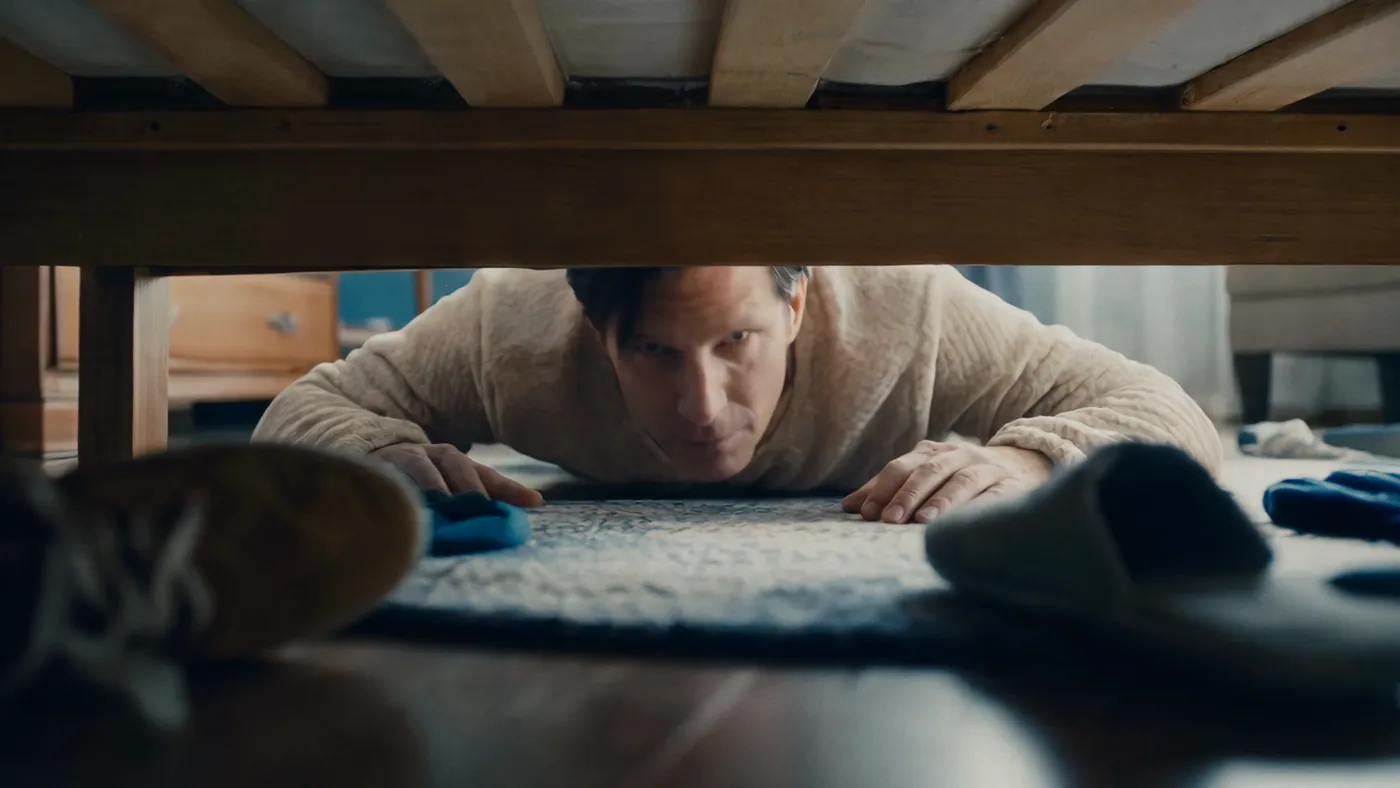
Frame from The Missing Pair, the four-minute launch short ByteDance Seed generated with Seedance 2.5 — click through to watch it on the Seed launch post (ByteDance Seed, July 31, 2026).
Seedance is the primary video model line from ByteDance, the parent company of TikTok and Douyin. The model family developed across several key dates:
- February 12, 2026: ByteDance releases Seedance 2.0 AI Image to Video, offering 15-second takes and native audio generation.
- June 23, 2026: ByteDance previews Seedance 2.5 at Volcano Engine's FORCE conference in Beijing, showing 30-second takes and 50-asset referencing.
- July 31, 2026: The Seed research team publishes its Seedance 2.5 launch announcement and puts the model in Jimeng and Doubao Pro.
- July 31, 2026: Dreamina outlines global subscriber rollouts across Europe, Asia, the Middle East, and South America, while the US was not on that list.
- August 7, 2026: Cloud API endpoints open on Volcano Engine Ark (
doubao-seedance-2-5-260628) and BytePlus ModelArk (dreamina-seedance-2-5-260628), alongside resellers like fal.ai.
The model shifts AI video from brief loops toward long, continuous takes with stable character identity.
Start Creating with Seedance 2.5
Testing Seedance 2.5 does not require local graphics cards, command lines, or custom API keys. You can run generation jobs directly in your browser through Seadanse.
To start, write a shot list describing your subjects, scene lighting, and camera paths in the prompt box. Pick a resolution — 480p, 720p or 1080p. Set your desired clip length between 5 and 30 seconds.
Leave the audio toggle turned on to make dialogue, background sound, and music alongside the video. When your parameters are ready, click Generate on the Seedance 2.5 AI Video Maker.
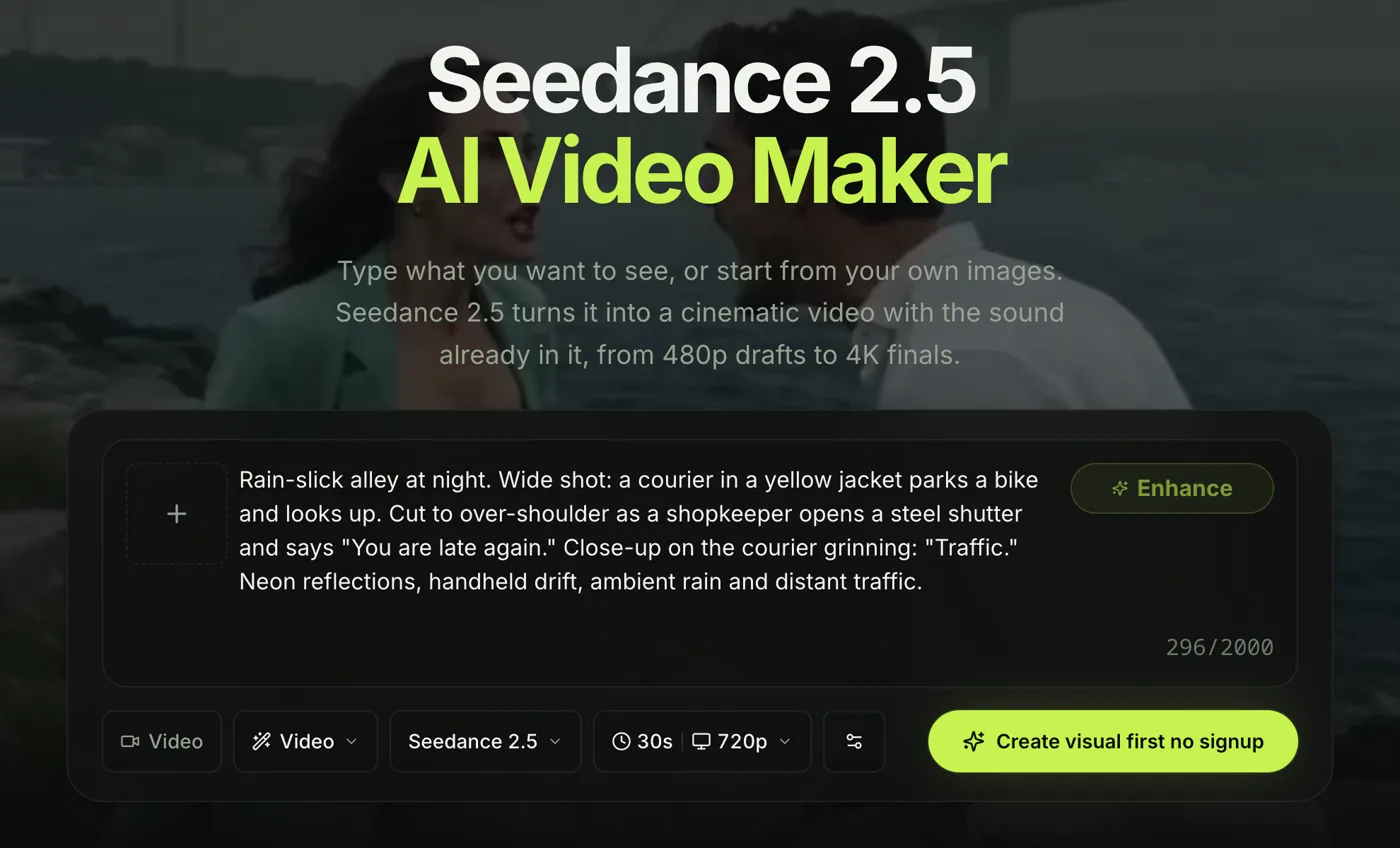
The Seedance 2.5 preset inside the Seadanse generator, set to 30 seconds at 720p — screenshot taken August 19, 2026.
The exact credit price shows on the Generate button before you click. If an upstream error or system timeout stops the job, your credits are refunded automatically. The workspace also supports image-to-video workflows and first-frame or last-frame controls to guide scene layout.
Why Seedance 2.5 Feels Different
One take instead of a stitch. Earlier video models produced short clips that creators had to cut together in editing software. That stitching process often caused faces to distort, lighting angles to jump, and clothes to change between shots. Seedance 2.5 renders a single continuous 30-second camera path. It keeps character appearance, background sets, and lighting stable across the entire sequence.
Sound and picture made in the same pass. Instead of generating silent frames and adding synthetic sound later, the model creates sound and picture together. As Gregor Kobsik wrote in The Decoder on August 1, 2026:
It generates video and audio in one pass, producing clips up to 30 seconds long that can be extended multiple times.
Speech and sound effects are made alongside the video frames. Spoken lines land directly on mouth movements. Physical impact sounds hit on the exact frame of action.
Key Features of Seedance 2.5
The model introduces five major technical upgrades spanning duration, reference tracking, multilingual audio, timestamp editing, and output formats.
30-Second Single Takes and Two Extensions
The base single-pass generation window spans from 4 to 30 continuous seconds. This doubles the 15-second limit found in Seedance 2.0.
On the API, setting the duration parameter to -1 lets the model pick an appropriate shot length from the prompt.
According to ByteDance's official landing page, users can extend generated clips twice after the initial render. This keeps the scene environment and character cast intact across extensions.
Inside consumer tools like Jimeng and Dreamina, a separate beta long-video mode chains extensions together. That product feature produces finished videos up to 180 seconds in length from a single project.
Up to 50 References Across Images, Video, and Audio
Reference capacity is much larger than in earlier model releases. Seedance 2.5 accepts up to 30 reference images, 10 video clips, and 10 audio files in a single run, adding up to 50 references.
By comparison, version 2.0 accepted a maximum of 9 images, 3 video clips, and 3 audio files.
Reference video and audio clips can span a total combined duration of 30 seconds, up from 15 seconds in the previous release. Min Choi, writing about the workflow on X, put it this way: "the prompts aren't descriptions. They're mostly restrictions," and "one good reference beats five mediocre ones."
Giving the model clean reference files yields much tighter character identity than feeding it dozens of conflicting angles.
Audio and Video in One Pass, Eleven Languages, and Audio-Only Input
Audio generation is enabled by default across standard runs. It delivers a synchronized mono output track that combines speech, sound effects, and musical backing.
The Volcano Engine ModelArk tutorial lists native support for eleven languages:
- Chinese
- English
- Spanish
- Indonesian
- Malay
- Thai
- Arabic
- Portuguese
- Vietnamese
- Japanese
- Korean
Seedance 2.5 is also the first model in the series to accept an audio track as its sole input. So you can start from a voice recording or a music track instead of a text prompt.
Timestamp-Guided Editing and Scene Continuation
Instead of throwing away a 30-second render to fix a single background flaw, creators can modify specific parts using timestamp instructions.
The API lets you change the subject, add or remove specific objects, or repaint visual regions across chosen time ranges.
The model also supports scene continuation workflows. This feature extends an existing video while keeping the style and cast intact. It allows creators to continue action beats across sequential generations without resetting character looks or environmental styling.
Resolution Tiers, Formats, and Aspect Ratios
On the API, the model renders at 480p, 720p, and 1080p at 24 frames per second. It supports six standard aspect ratios: 21:9, 16:9, 4:3, 1:1, 3:4, 9:16, or an adaptive ratio. High-definition 1080p renders output as 10-bit H.265/HEVC video files. The 1080p tier was added to the API around mid-August 2026.
There is no native 4K rendering on Seedance 2.5. ByteDance's earlier announcements mentioning native 4K applied strictly to the Seedance 2.0 release. Any third-party platform offering 4K on 2.5 is using post-render upscaling.
Our guide to Seedance 2.5 resolution covers how the tier list got here and why the 4K claim keeps circulating anyway. On Seadanse today, the Seedance 2.5 generator provides 480p, 720p and 1080p across durations from 5 to 30 seconds.
Seedance 2.5 vs Seedance 2.0 vs Wan 3.0
The comparison table below details the technical specifications and practical trade-offs among current leading video models.
| Seedance 2.5 | Seedance 2.0 | Wan 3.0 | What it means for you | |
|---|---|---|---|---|
| Max single take | 30 s (+2 extensions) | 15 s | 30 s | Longer takes = fewer cuts to hide, but each render costs more |
| References | 30 images / 10 videos / 10 audio | 9 / 3 / 3 | 10 images / 5 videos / 5 audio | More references = tighter identity lock, if they do not contradict each other |
| Native audio | Yes, default on | Yes | Yes | Skip the separate audio pass |
| Resolution (API) | 480p / 720p / 1080p | 480p / 720p / 1080p / 4K | 480p / 720p / 1080p | Need true 4K today? That is 2.0's card, not 2.5's |
| Timestamp editing | Yes | — | — | Fix one shot without re-rolling the take |
| Best for | Dialogue scenes, multi-shot ads, reference-heavy character work | Cheaper multi-shot clips, 4K masters, first/last-frame control | Long establishing shots and B-roll on a budget | — |
A dash (—) means the vendor's API reference does not document that feature as of August 2026. Sources: Volcano Ark model reference, BytePlus rate card, Alibaba Wan 3.0 reference and pricing.
Other competing models offer different balances. Kling 3.0 renders up to 15 seconds per generation with native 4K support and audio capabilities. Meanwhile, Google's Veo 3.1 tops out at 8 seconds with a maximum of three reference images. Neither tool currently supports a 30-second single take.
In an independent test, Curious Refuge compared practical results between Seedance 2.5 and Alibaba's Wan 3.0 on August 14, 2026:
We still think Seedance 2.5 is the better overall AI video model. It produced stronger results for emotional performances, visual effects, compositing, lip syncing, and complex multi-shot scenes. But it didn't win every test.
Their price question was blunter: "Is Seedance 2.5 four times better than Wan 3.0? In many cases, we don't think it is."
Creators can compare both systems directly by running identical prompts on the Wan 3.0 AI Video Generator and Seedance 2.5.
What Drives the Cost of a Seedance 2.5 Render
The compute cost of a Seedance 2.5 render scales with two main variables: output resolution and duration.
At the API level, a 720p second costs roughly 2.2 times a 480p second, and a 1080p second roughly 3.9 times. This follows a standard pixel formula based on height, width, frame rate, and runtime. Duration scales in a direct line. A 30-second continuous take costs six times as much compute as a 5-second clip.
At the source, Seedance 2.5 is noticeably more expensive than version 2.0. As Chinese trade publication 36Kr reported in an industry cost analysis, a 30-second video represents "a 50% price increase compared to version 2.0."
Commercial platforms wrap these underlying compute costs into credits, and subscription packages vary widely. As detailed in our review of the Higgsfield unlimited Seedance 2.5 offer, plans marketing unlimited generations often hide long queue times and lower resolution limits behind their flat monthly rates.
On Seadanse, generation pricing is transparent and flexible:
- New accounts receive free starter credits upon sign-up with no credit card required.
- You can purchase an entry credit pack for $9.9 without signing up for a recurring subscription.
- All purchased credits remain valid for 12 months from the date of purchase.
- The exact credit price shows clearly on the Generate button before you submit a task.
- Any failed or interrupted renders are refunded to your account balance automatically.
- All exported videos come without watermarks.
To see full rate tables and calculate your project budget, visit our Seedance 2.5 pricing page. You can also test your shot list in the AI video cost calculator for Seedance 2.5. If you want to draft ideas at a lower cost, lightweight alternative models like Seedance 2.0 Mini and Seedance 2.0 Fast provide faster tries in a cheaper pricing lane.
Who Gets the Most From Seedance 2.5
The model's shot length and reference tracking benefit four primary creative groups.
- Short narrative drama and filmmaking. Independent filmmakers and episodic creators can generate continuous scenes with stable character tracking and synchronized speech. In an early review and masterclass on August 5, 2026, filmmaker Tim Simmons called it "a very good model that is on the road to becoming a great model." He cut a two-and-a-half-minute short film from about fifteen 30-second generations.
- Product marketing and commercial advertising. Commercial teams can lock product packaging using reference images to produce clean promotional clips with consistent textures. Generating synchronized sound effects and background scoring in the same pass removes the need to license basic Foley audio for quick social ads.
- Previsualization and pitch development. Directors and visual agencies can block camera moves, actor staging, and scene timing without stitching brief four-second clips. Delivering complete 30-second previz sequences with synchronized audio gives production clients a clear look at narrative pacing during pre-production.
- Independent social content creators. Creators producing vertical videos can render 9:16 dialogue clips and visual hooks with native voice tracks in one step. While high-volume creators may still use Seedance 2.0 Mini for rapid drafts, version 2.5 serves as a reliable option for finished hero assets.
Possible Limitations and Open Questions
Here is where it falls short, each point with its source.
-
No native 4K mastering, and 1080p is new. The API tops out at 1080p, a tier that only arrived in mid-August. Testing before it landed, Simmons recommended "generating at 720 and then just upscaling after the fact" rather than expecting native ultra-high-definition output from the base model — the advice still holds, with 1080p as the better starting point.
-
Physics inconsistencies in multi-subject scenes. Complex physical motion and crowded group interactions can cause motion errors. ByteDance Seed says so itself in the launch post: "there is still room for improvement, particularly regarding the physical plausibility of complex motions and the stability of scenes involving interactions among multiple subjects."
-
Visual morphing during fast action sequences. Rapid physical movement or fast camera pans can cause subject anatomy or props to warp. Simmons saw "decoherence and morphing issues … especially in like the big action sequences," while noting that "it does not always occur and it is not persistent through the entire generation."
-
Thirty seconds costs thirty seconds. Rendering fees scale directly with runtime. A full 30-second take carries a substantial compute cost even if you only keep a short piece. Simmons' advice: "have an idea of what you're generating before you crank that knob over to 30 because, well, it's going to cost you."
-
Version 2.0 prompts do not carry over cleanly. Prompts written for older releases often fail to produce optimal results on the new model. Simmons: "prompting in 2.5 is a bit of a different beast and some of your 2.0 prompts will not translate very well over." Min Choi made the same point: good prompts are mostly restrictions, not descriptions.
-
Strict copyright and likeness moderation. The platform enforces strict filters against protected intellectual property and real human faces. An industry study reported by Deadline on copyright blocking found that Seedance 2.5 "blocks around 80% of prompts involving copyrighted material" and that "100% of attempts to create videos from copyrighted images were unsuccessful." Volcano Engine rules also explicitly refuse reference media containing real human faces.
-
Upstream task queues, 24-hour URLs, and platform parameters. The upstream API limits how many jobs run at once and queues the rest. Raw API download links expire after 24 hours. On Seadanse, generated videos are kept safely in your account. The model is currently available at 480p, 720p and 1080p for durations between 5 and 30 seconds without multi-round extensions.
Seedance 2.5 FAQ
Is Seedance 2.5 the latest video model from ByteDance?
Yes, it is the newest release in ByteDance's video series as of August 2026. The model line spans Seedance 1.0, Seedance 1.5 Pro, Seedance 2.0 from February 2026, and Seedance 2.5, which launched on July 31, 2026, with API availability starting August 7, 2026.
Can I use Seedance 2.5 for free?
The model is metered per second everywhere it runs, so generating video is not entirely free. Most platforms, including Seadanse, give new accounts free starter credits without requiring a credit card. Beyond your initial test runs, you can buy a small credit pack starting at $9.9 with no subscription. The exact credit price shows on the button before you click.
Is Seedance 2.5 available in the United States?
Yes, though access depends on which platform you use. Dreamina's initial subscriber rollout excluded the US market. In the US, the practical routes are the BytePlus ModelArk API and web apps like Seadanse, which needs only an email sign-up.
Who owns and built Seedance 2.5?
The model is owned and developed by ByteDance, the parent company of TikTok and Douyin. Model research and training are managed by ByteDance's internal Seed research group.
What maximum duration and resolution does the model offer?
The model produces single continuous takes up to 30 seconds, with support for up to two sequential extensions. Cloud APIs render at 480p, 720p, and 1080p at 24 frames per second. On Seadanse, you can generate clips between 5 and 30 seconds at 480p, 720p or 1080p.
Is there a developer API for Seedance 2.5?
Yes, official API endpoints have been available on Volcano Engine Ark and BytePlus ModelArk since August 7, 2026. Resellers include fal.ai, Replicate, and WaveSpeed. Seadanse provides a browser-based creative interface rather than raw developer API access.
Final Verdict
Seedance 2.5 delivers a major leap forward for AI video creation. It combines 30-second continuous takes, native sound generation, and up to 50 reference assets into a single model. This setup makes it much easier to build complete narrative scenes and commercial product videos without relying on multi-clip post-production stitching. While fast action scenes still show occasional visual morphing and long takes require careful prompt planning, the model provides steady character consistency across extended shots. You can test your prompt ideas directly in your browser on the Seedance 2.5 AI Video Maker.
The Seadanse Team — we cover AI video generation: model specs, API pricing, and what the marketing leaves out. Facts in this article were checked against ByteDance Seed's launch post, the Volcano Engine and BytePlus documentation and the named third-party tests on August 18-19, 2026.
Related Articles
- Seedance 2.5 Resolution: 480p, 720p and 1080p — and Why "Native 4K" Isn't Real — the tier list, the 4K myth, and how to get a 4K master anyway
- Seedance 2.5 "Unlimited" on Higgsfield: 33 Days of Fine Print — what "unlimited" costs in queues and caps
- 7 Best Runway Alternatives in 2026 (Tested and Compared) — where Seedance-based tools sit against Runway


